SCOFMP & LIFC
The South Central Oregon Fire Management Partnership is an interagency fire management program that provides comprehensive wildland fire service to south central Oregon and northwest Nevada.
The partnership strives to achieve a more efficient, effective and integrated interagency fire management program for all participating agencies on the land administered and protected by each agency. Dispatching is performed by the Lakeview Interagency Fire Center (LIFC).
Mission Statement
The mission for Lakeview Interagency Fire Center (LIFC) is to provide high quality service to all of our partner agencies in the most efficient and cost-effective manner possible while providing for firefighter safety at all times. All actions will be consistent with land and resource management objectives and current incident management direction.

Recorded Message of Fire Restrictions for Camping, Woodcutting, etc. (541) 947-6259
Fire Area Emergency Closures
News
ODF Declares 2026 Fire Season; SCOFMP Agencies Align Under Early-Season Conditions
Monday, May 18th, 2026, 3:21:52 PM PDT
Lakeview, Oregon - LAKEVIEW, ORE. Due to low snowpack, minimal spring precipitation, and prolonged above‑average temperatures, the Oregon Department of Forestry (ODF) Klamath‑Lake District will officially declare fire season in Klamath and Lake counties beginning Friday, May 22, 2026, at 12:01 a.m. This declaration applies to all private, county, and state wildlands protected by ODF.
In support of ODFs declaration, all agencies within the South Central Oregon Fire Management Partnership (SCOFMP) will begin coordinated fire season operations at the same time. This includes the Fremont‑Winema National Forest, the Bureau of Land Management (BLM) Lakeview District, the Sheldon‑Hart Mountain and Klamath Basin National Wildlife Refuge Complexes, and Crater Lake National Park.
As the upcoming holiday brings increased recreation activity and more people into the woods, the public is urged to use extra caution and do their part to help prevent wildfires. Abandoned campfires remain one of the leading causes of human-caused wildfires on public lands. While many campfires are safely extinguished, it only takes one escaped fire to threaten lives, damage property, and impact natural resources for years to come. On private lands, escaped debris burning continues to be a leading cause of human caused fires. With the declaration of fire season, all debris burning is prohibited without a permit.
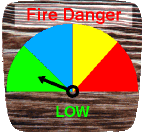
Fire danger level will be Moderate, and the Industrial Fire Precaution Level (IFPL) will be I.
Moderate Fire Danger means:
Fires can start from most accidental causes, but the number of fire starts is generally low.
Fires in open cured grasslands will burn briskly and spread rapidly on windy days.
Timber fires spread slowly to moderately fast.
IFPL I: Closed Season - Fire precaution requirements are in effect. A Fire Watch is required at this and all higher levels unless otherwise waived.
Fire extinguisher and shovel must be with each chainsaw.
Fire extinguishers must be in all vehicles.
Chainsaws must have a .023-inch mesh screen installed in the exhaust.
Approved spark arresters must be on all internal combustion engines.
Watchmen service must be provided for 1 hour after the shutdown of power equipment for the day unless otherwise specified.
No smoking is permitted while working or traveling through any operations area on public land except while in enclosed vehicles.
Permits to burn are required unless waived in advance.
For the Oregon Department of Forestry, the Fire Season in Effect declaration puts regulations in place that restrict debris burning and timber harvest operations. Wildland and structural fire protection agencies in Klamath County have agreed to prohibit all outdoor debris burning. Forest operations that require a Permit to Operate Power-Driven Machinery must now have fire tools, an on-site water supply, and watchman service on privately owned forestland.
Declaring Fire Season also prohibits: 1) Smoking while working in or traveling through any operation area. 2) The use of fuse and caps for blasting, unless approval is granted by the forester. 3) The discharge of exploding targets inside the district or within one-eighth mile of the district. 4) The discharge of tracer ammunition on land within the district or within one-eighth mile of the district, or when the ammunition, once discharged, crosses over land within the district or within one-eighth mile of the district.
For more information visit: https://www.oregon.gov/odf/fire/pages/default.aspx, or contact the local ODF offices: Klamath 541-883-5681, Lake 541-947-3311
In conjunction with the declaration of the 2026 fire season, all lands managed by the Bureau of Land Management within half a mile of the Klamath River from the Keno Dam downstream to the Oregon/California border fall under this fire prevention order went into effect May 22nd. Anyone who is found guilty of violating a fire prevention order may be subject to prosecution under any applicable law or BLM regulation. A violation of this order may be classified as a Class A Misdemeanor Offense under 43 USC 1733(a) FLPMA, 18 USC 3559, and 18 USC 3571 Sentence of Fine - Sentencing Reform Act, Oct. 12, 1984. If the violation does not result in death, anyone who violates this order may be fined not more than $100,000 and/or imprisoned for not more than 12 months or may be fined in accordance with the applicable provisions of 18 USC 3571. Restitution for total fire suppression and damage costs incurred will be borne by the responsible party.
Human-caused wildfires are preventable, and we ask the public to do their part in helping reduce wildfire risk. Stay up to date on seasonal changes by visiting our website or Facebook page.
For more information and current fire restrictions, visit https://www.scofmp.org/
Prescribed Fire Season starting in South Central Oregon
Tuesday, October 14th, 2025, 1:57:29 PM PDT
Lakeview, Oregon - LAKEVIEW, Ore. Prescribed fire season has arrived in South Central Oregon. Fire managers from the Fremont-Winema National Forest, Lakeview District Bureau of Land Management, The Klamath Tribes, Crater Lake National Park, Klamath Basin National Wildlife Refuge Complex, and Sheldon-Hart Mountain National Wildlife Refuge Complex will be applying prescribed fire across the landscape in the coming months.
With the recent precipitation and snow accumulation at higher elevations, South Central Oregon fire managers will begin their prescribed fire efforts and hazardous fuel reduction work throughout the next few months. The SCOFMP area will conduct pile burning in various locations across southern Oregon. These piles consist of vegetation and debris generated from hazardous fuels reduction and post-fire recovery projects. The goal of these treatments is to reduce wildfire risk, improve forest health, and support long-term reforestation efforts. The recent snow fall will help piles stay within their footprint
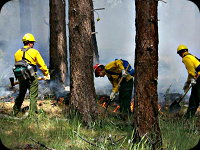
Prescribed fire is a vital tool used to improve forest health, enhance wildlife habitat, and reduce hazardous fuels, helping to minimize the risk of high-intensity, catastrophic wildfires. These efforts reflect our ongoing commitment to protecting communities, and natural resources from wildfire threats.
Residents and visitors may notice smoke or fire activity on public lands throughout the region. Each prescribed fire may look different depending on the forest type, fuel load, prescribed fire objectives, and how long fire has been absent from the landscape. Locations where prescribed fire operations are underway will be clearly marked and may have increased fire personnel, traffic, and smoke. For your safety and the safety of firefighters, please avoid these areas when possible.
Prescribed burns are only conducted on days when the Oregon Department of Forestry Smoke Management Office confirms suitable weather conditions for smoke dispersal. Once approved, and if overall fuel and weather conditions are favorable, firefighters begin with a test fire before proceeding. If conditions are not safe, the burn will be postponed. All prescribed fire operations are closely monitored and patrolled frequently by fire professionals, to ensure public safety.
Employees of the South Central Oregon Fire Management Partnership are dedicated to a safe and successful prescribed fire season, for both the public and our team.
FIRE RESTRICTIONS LIFTED WITHIN CRATER LAKE NATIONAL PARK
Tuesday, October 14th, 2025, 1:51:08 PM PDT
Lakeview, Oregon - Crater Lake National Park - The fire danger level within Crater Lake National Park has dropped from high to low due to recent moisture and predicted cooler temperatures. Effective October 15 at 00:01 am, Crater Lake National Park will rescind fire restrictions implemented on July 4, 2025. To ensure public safety and to provide the highest degree of protection to park resources, the following regulatory provisions apply to fires within Crater Lake National Park
Campfires The lighting or maintaining of fires is generally prohibited, except as provided for in the following designated areas or receptacles, and under the conditions noted:
Mazama Campground in grills or grates provided in designated campsites.
Within National Park Service or concession residential areas, by residents and their guests, within grills and/or fire grates that fully contain the fire.
Fires must be fully contained within established fire grills, grates or rings. No bonfires (large fires that spill outside of the fire receptacle, use stacks of flammable material such as cardboard boxes or wood pallets or have excessive flame heights that could easily become uncontrolled) are allowed.
Fires will be constantly monitored while burning and will be completely extinguished after use.
Fireworks Fireworks are prohibited in the park at all times.
Specific fire locations and other information can be found on the LIFC Incidents Information Report
NIFC National Fire News
Large Incident Information - InciWeb